
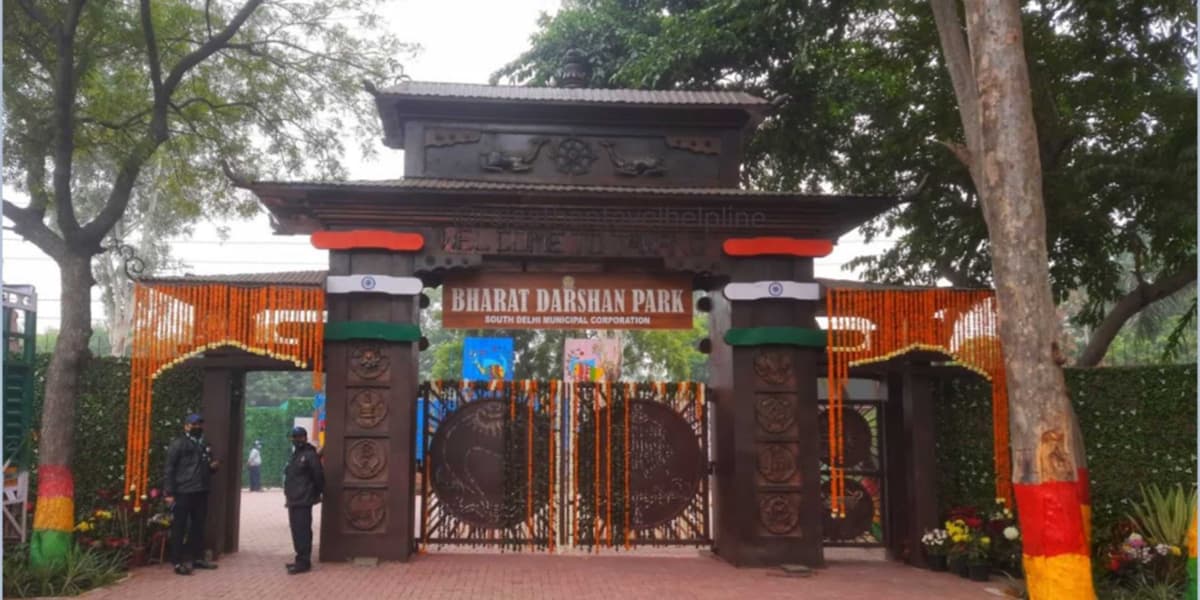
Do you want to tour the entirety of India in a single place? In that case, the Bharat Darshan Park in New Delhi will be the best place to visit. The park is situated in Punjabi Bagh, Delhi and is developed on the concept of Waste to Wonder, where the replicas of historical monuments of India have been made of pure scrap and waste materials.
We shall furnish you with all the details of Bharat Darshan Park in Delhi. Whether you are looking for the Ticket Price, Timings, or the Nearest Metro Station, you will find the answer to every question right here.
What is Bharat Darshan Park?
Constructed by the South Delhi Municipal Corporation (SDMC). It is a good example of the Scrap to Art concept in this park. In this case, the images of 22 historical monuments have been made out of scrap material, which weighs around 350 tons comprising of old cars, iron bars, nuts and bolts and electric poles.
This park not only creates a powerful impression of environmental conservation, but it has also been one of the most popular places to visit in Delhi with family.
Bharat Darshan Park Ticket Price 2026
The ticket prices for entry into the park vary depending on the time of day, such as daytime or evening. The park's lighting in the evening makes it incredibly beautiful, which is why the evening ticket is slightly more expensive. You can see the Bharat Darshan Park Ticket Price in the table below:
| Category | Day Time (Before 5:00 PM | Evening Time (After 5:00 PM) |
|---|---|---|
| Adults | ₹100 | ₹150 |
| Children (Below 12 years) | ₹50 | ₹75 |
| Senior Citizens | ₹50 | ₹75 |
| MCD School Students | Free | Free |
Note: Ticket prices are subject to change over time. You can use the Bharat Darshan Park Online Ticket Booking facility to secure your spot in advance or purchase tickets directly from the park counter.
Bharat Darshan Park Timings
Please, be careful about the schedule, in case you are going to attend: Opening Time: 10:00 AM
- Closing Time: 10:00 PM
- Weekly Off: Monday
Bharat Darshan Park is said to be best visited during the evening hours, more so after the sun sets. The sight is simply spectacular when there are colorful lights illuminating all the monuments. It is usually most comfortable to visit between 6:00 PM in the summer and 3:00 PM in the winter.
How to Reach Bharat Darshan Park by Metro
This park is situated in the Punjabi Bagh area of West Delhi Day Trip. Reaching here is relatively easy via public transport.
- Address: Ring Road, Punjabi Bagh Chowk, New Delhi. Nearest
- Metro Station: The nearest one is Punjabi Bagh West Metro Station on the Pink and Green lines. The metro station and the park are located within a radius of about 700-800 meters and can be covered within 5 minutes by walking or riding an E-rickshaw.
In case you come by car, there is also a special car park close to the park.
The Journey of the Monuments at Bharat Darshan Park New Delhi
The biggest highlight of this park is the 22 historical structures present here. You will get to see glimpses of India ranging from Kashmir to Kanyakumari. Some of the major monuments present at Waste to Wonder Park Punjabi Bagh include:
Taj Mahal Agra: This ivory-white marble mausoleum was commissioned by the Mughal emperor Shah Jahan between the years 1632 and 1648 and it was built as a reminder of their everlasting love for his beloved wife Mumtaz Mahal. It is a UNESCO World Heritage Site and an international symbol of eternal love and the perfection of Indo-Islamic architecture.
Qutub Minar Delhi: The highest brick minaret in the world, 72.5 meters (built between 1199 and 1220) by Qutbu-d-Din Aibak after the Ghurid conquest to signify the introduction of the Islamic rule in India, the best combination of Hindu and Muslim architecture.
Gateway of India Mumbai: The 26-meter-high monuments of the Indo-Saracenic architecture that were completed in 1924 to honour the visit of King George V in 1911 were turned into an emblem of Indian independence as the last of the British troops left through it in 1948.
Konark Sun Temple Odisha: The great temple was constructed in 1250 AD on the command of the king Narasimhadeva I, and was shaped like a gigantic stone chariot with 24 heavily carved wheels. It is regarded as the best masterpiece of Kalinga architecture and currently it appears on the 10 rupee bank note of India.
Hawa Mahal Jaipur: This is a pink sandstone 5-storey palace that was constructed in 1799 containing 953 detailed latticed windows that are designed to give its royal women a chance to view the activities in the street without being noticed hence the official symbol of the city of Jaipur branded the Pink City.
Sanchi Stupa Madhya Pradesh: This refers to the Great Stupa, which was originally commissioned by the emperor Ashoka in the 3rd century BCE to contain the relics of Buddha, though through the development through the centuries it grew larger and carved with beautiful toranas to illustrate the Buddhist legends and to be featured on the 200 note of India.
Nalanda University Bihar: The first residential institution in the world located in 427 CE by Emperor Kumaragupta I, with a history of 800 years that saw the attraction of thousands of Buddhist thinkers in China, Tibet and the rest of Asia, was built as a beacon of ancient Indian intellectual education.
Mysore Palace Karnataka: This three-story gray granite building was constructed during 1897-1912 under the Indo-Saracenic style by architect Henry Irwin and is the official residence of the royal family, Wodeyar dynasty and has fancy turrets, a set of carvings as well as a tall tower of 145 feet and a golden-plated dome.
Charminar, Hyderabad: A square structure, topped with four fancy 56-meter-high minarets constructed in 1591 by Sultan Mohammed Quli Qutb Shah, weighing 14000 tonnes, with the foundation stone carved with prayers to the prosperity of the city, and now the symbolic center of Hyderabad.
Khajuraho Temple Madhya Pradesh: Rich in Nagara style architecture with more than 870 complex carvings such as erotic sculptures of kama and Hindu-Jain religious tolerance due to the many temples of different faiths built there between 885 and 1050 CE, the Khajuraho Temple is the masterpiece of the Chandela dynasty.
Ajanta and Ellora Caves Maharashtra: The Ajanta Caves cover 30 rock-cut Buddhist monasteries dating back to 2 nd century BCE to 480 CE and the nearby Ellora Caves include 34 temples dated to the 5th-10th centuries representing the religious pluralism of India and the rock-cut architecture.
Hampi Karnataka: Hampi in the Tungabhadra River basin of Karnataka has over 1,600 monuments of the Vijayanagara Empire 13361570 CE had become the City of Ruins following a military defeat and despoiling in the 16th century. It is currently a UNESCO World Heritage site and the last great Hindu kingdom of South India.
Victoria Memorial Kolkata: This is an Indo-Saracenic structure, a 56-meter-tall edifice with 25 galleries that hold a collection of more than 50,000 artifacts and 64 acres of beautiful gardens, and receives 5 million visitors each year.
Badrinath and Dwarkadhish Temple: Badrinath Temple in Garhwal Himalayas was a 15th-16th century five-storied limestone structure erected by Adi Shankara in the 9th century, as part of the sacred Char Dham circuit and Dwarkadhish Temple in Gujarat is a 5-storied structure (built using limestone) erected by Adi Shankara in the 9th century as one of the four places of worship.
All these replicas are so meticulously crafted that when one stands before them, it feels as if one is looking at the actual monument.
Facilities Available at the Park
- Food Court: A great food court has been constructed within this park where one can have a taste of the Delhi street food. A unique feature is that the chairs here are made using old tires and scooters.
- Walking Track: It has beautiful walking tracks where one can walk in the morning or evening.
- Photography is not prohibited at this location and it's a paradise for social media enthusiasts and those who create Instagram Reels.
- Washrooms & Drinking Water: Clean washrooms and water arrangements are available for the convenience of tourists.


