
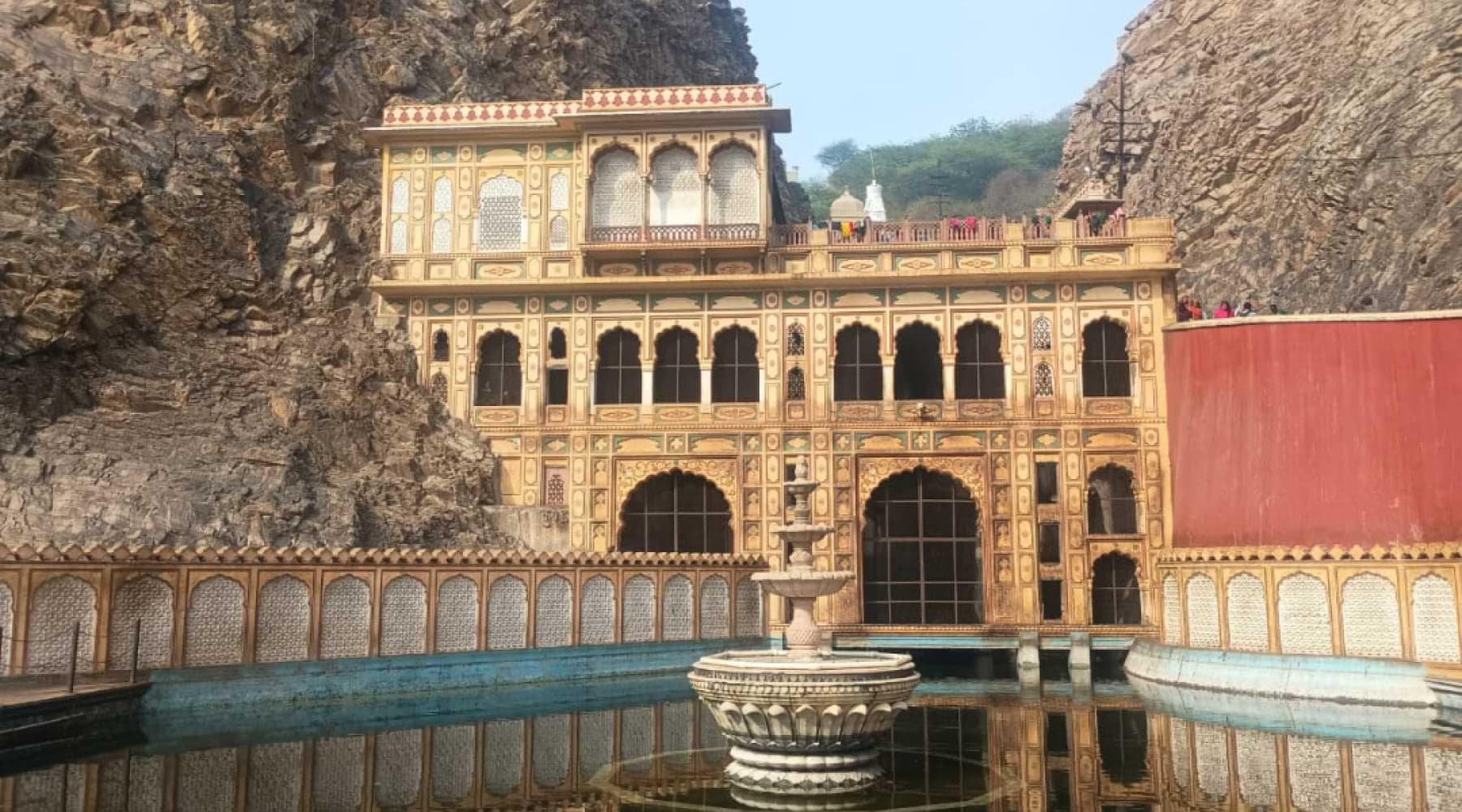
Have you heard of the Monkey Temple in Jaipur. It is known as Galta Ji Temple and it is one of the most interesting sites to visit in Rajasthan. This temple is situated between beautiful hills and is situated 10 kilometers outside of Jaipur city and is home to hundreds of monkeys playing. It is not only a place where one can find animals, it is a spiritual home with hundreds years old stories. Let me tell you all about it.
The Amazing Story of Galta Ji Temple
Why This Temple Is So Special in Hindu Religion
This is named Galta Ji Temple to honor a renowned saint Rishi Galav. This saint arrived, long, long ago, to these hills, and spent over 100 years in meditation (thought deeply). He struggled so much on his spiritual path that the deities granted him some magical power, a spring of water that does not run dry even in the desert of Rajasthan, which is hot and dry.
This water is deemed to be very sacred. Human beings assume that it is originated by the River Ganges. You are supposed to cleanse all your sins when you take a bath in this water, and you get holy in your spirit. This is the reason why they make people come here even now to take bath in these holy pools known as the Sacred kunds of Galta Ji.
Once in a year, there is a special festival known as Kartik Purnima (the full moon night of the Hindu month of Kartik). On this night, people believe that the three most essential gods Brahma (who created the world), Vishnu (who protects it) and Shiva (who transforms it) actually visit this temple! Thousands of people come to bathe in the holy water during this festival because they think it brings them blessings from these gods.
There are also many monkeys here, and for Hindus, this makes the temple even more special. Monkeys are seen as sacred animals because of their connection to the Lord Hanuman Temple Jaipur, a very important god in Hinduism who is known for his devotion and strength.
The Story of Rishi Galav: The Saint Who Meditated Here
Who Was This Saint ?
- Before we can better understand the temple, we need to learn about the saint after whom the temple is named. Rishi Galava appears in the Mahabharata, one of the India's most famous ancient books. He was a student of another great saint named Maharishi Vishvamitra.
- When Galava graduated under his guru (teacher), he wished to offer a special gift to him in order to express his appreciation and gratitude to him. This ritual is referred to as Guru Dakshina. But their guru demanded something that seemed impossible: he would have 800 white horses and he would have one black ear on each horse!
The Impossible Task
- Now, Galav didn't have any money or power. He was just an ordinary saint. But he didn't give up. He prayed to a divine bird called Garuda for help. The bird took him to a kind king named Yayati.
- The king did not have 800 horses to give, but he had a beautiful and intelligent daughter named Madhavi. The king agreed to help. Galav arranged for Madhavi to marry four different kings, and each king gave 200 horses as a gift for marrying her. In total, Galava received 800 horses.
- He returned to his guru with the horses and completed his task. This story teaches us that if you work hard, stay honest and never give up even when things seem impossible, you can achieve anything.
- This saint's dedication was so strong that the place where he meditated became sacred. That place is now called the Galta Ji Temple.
The Sun Temple at Galta: A Special Spot
What Is the Sun Temple ?
- When you get to the top of the hills at Galta, you will come to a special temple, named Surya Mandir, or the Sun Temple. It is constructed literally on the top of the eastern hill, which is logical since the sun is rising in the east.
- This temple was constructed when Maharaja Sawai Jai Singh II was the king of Jaipur and he was the one who established the city of Jaipur. Hinduism has a Sun God (Surya) who is quite significant. He symbolizes light, dynamism and life itself.
A Beautiful Walk Up
- It is a 15-20 minutes walk to the Sun Temple. It is a pleasant walk in the natural hills. The best thing is that when you arrive on the top, you see splendid views of the whole pink city of Jaipur beneath you. You can see the sunrise in the Morning, which is truly beautiful and a magical experience, should you go early in the Morning.
- The Sun Temple opens in the sunrise and ends on the sunset, it is understandable that this temple is devoted to the sun! This temple has been maintained by a family of priests and the traditions throughout the centuries.
The History and Stories Behind the Temple
How Old Is This Temple?
- Although people have been worshiping Galta Ji Temple as a sacred spot for at least 500 years, the current temple structures were constructed about 300 years ago (in the 1700s). Most of the temple was constructed by a man named Diwan Rao Kriparam, who was a minister of Maharaja Sawai Jai Singh II.
- A few historians believe that there may have been an earlier Shiva temple here, perhaps 1,400 years old, but all that now remains of it are a few cave temples cut out of the rocks.
The Beautiful Pink Buildings
The entire temple is made from pink sandstone, the same stone used to build many important buildings in Jaipur. The temple buildings look more like a fancy palace than a typical temple. It has:
- Beautiful domed ceilings (round ceilings above)
- Fancy carved stone pillars with detailed designs
- Several courtyards (open areas surrounded by buildings)
- Colorful paintings on the walls showing stories from Hindu mythology
- Arched gates that show the influence of Mughal architecture
A Very Important Religious Center
- This temple is unique in that it serves as the hub of one of the Hindu traditions known as the Ramanandi sect. It is a tradition that centers on the worship of Lord Rama and which teaches that everybody is equal before God, that you do not have to be rich or belong to a good family to access God. Around 600 years ago, a great saint named Payohari Krishnadas came here and established this sect at Galta. From here, the movement spread across all of North India.
- A leader runs the temple called an "Acharya," and there has been an unbroken lineage of 17 different Acharyas (leaders) from the beginning to the present day. That's pretty amazing when you think about it—the same spiritual leadership for 600 years!
The Magic of the Sacred Water
- The most interesting aspect of Galta Ji Temple is the seven sacred water tanks known as kunds, which are supplied by underground natural springs. The most important one is the Galta Kund Jaipur, with water flowing out through a stone opening shaped like a cow's head.
- What's really amazing is that these springs never run dry, even during the hottest and driest months. People built these tanks hundreds of years ago using stone, and they still work perfectly today. This shows how skilled the builders were with water management and engineering.
- Another story is that Tulsidas, a famous saint who wrote the important Hindu book Ramcharitmanas, may have written some parts of it here while meditating. This adds to the literary importance of the place.
Suggested Read:- best company for rajasthan tours
Why Do People From Other Countries Love Visiting Galta?
Real, Living Spirituality: Galta is a real living place of worship, unlike many other old temples which nowadays are mere museums. Every day, priests perform prayers and rituals. People still come to bathe in the holy water. Monks and spiritual students still live here and meditate. It is not a tourist activity but it is life and actual faith.
When foreigners attend, they have the chance to observe authentic Hindu spiritual practices in front of their eyes. You do not see a play-you are seeing true religion and true piety. This is quite unique and difficult to locate.The Monkeys Are Amazing: The biggest attraction for international tourists. Monkeys! There are hundreds of monkeys here, of which are both small rhesus macaques and large gray langurs. They jump around, play in the water, steal food from visitor's bags and do all kinds of funny things.
For people coming from cities where they rarely see animals in the wild, seeing so many monkeys playing naturally and freely is incredible. The monkeys make the experience fun and memorable, and also reinforce the spiritual connection to the Lord Hanuman Temple Jaipur.It's Stunningly Beautiful: The place where this temple is located is breathtaking. It is located on a small valley in the midst of rocky hills of pink and orange stones. The mixture of ancient buildings, natural landscape, and all the activity creates a scene that looks like something from a movie. Photographers love this place.
Peace and Spirituality: Many international visitors are interested in meditation, yoga and spiritual practice. Galta offers a peaceful environment where you can actually experience Hindu spiritual traditions. You can meditate by the sacred pools, watch sunrise from the Sun Temple or just sit quietly and think. This is a genuine spiritual experience, not a tourist experience.
It's Affordable: Compared to most large tourist attractions in India where one has to pay a high entry fee, Galta Ji Temple is free or very cheap to foreigners visiting the country. This renders it affordable to low end travelers and backpackers. It is also easy to reach by road here with Jaipur also being just 10 kilometers away.
Latent to Other Jaipur Attractions: Since most of the visitors come to Jaipur to visit the magnificent forts and palaces of Jaipur City Palace and Amber Fort are the main places they visit. These are impressive but very touristy. Galta offers something completely different—a spiritual experience, nature, living religion, and wildlife. Many travelers enjoy combining a visit to the magnificent palaces at a truly spiritual experience in Galta.
Suggested Read:- Jaipur City Palace
Visiting Information: When to Go and What It Costs
How Much Does It Cost ?
Great news— Galta Ji Temple is very affordable!
| Who Is Visiting | Entry Fee |
|---|---|
| Indian people | Free |
| Visitors from other countries | Free or very small fee (₹50-100) |
| Camera/Photography | No mandatory fee (sometimes ₹150 asked) |
| Donations | completely optional—give if you want |
Most sources say entry is actually free for everyone. You may be asked for a small donation for the maintenance of the temple, but it is entirely up to you. Although a certain fee may be requested to take a photograph, a person can always negotiate the price or just have fun without being photographed.
When Can You Visit?
The temple is open every single day of the year:
- Opens: 5:00-5:30 AM (early Morning)
- Closes: 7:00-9:00 PM (evening)
- Prayer times (known as "Aarti"): 5:30 AM, 12:30 PM and 7:00 PM.
The best time to visit and the Aarti schedule.
Time Period Best For Aarti Timing
- Early Morning (5:30-8:00 AM) Spiritual experience, photography, pilgrims 5:30 AM
- Mid-Morning to Afternoon (8:00 AM-3:00 PM) General sightseeing 12:30 PM
- Late Afternoon (4:00 PM-7:00 PM) Sunset photography, sunset views, couples 7:00 PM
Going early in the morning means cooler weather, fewer crowds, a peaceful and spiritual atmosphere and excellent natural light for photography. Going in the late afternoon means the weather is cooler after the mid-day heat and you get great opportunities to take stunning sunset photos.
The Best Months to Visit
- October to March: This is perfect! The weather is nice (not too hot, not too cold), the sky is usually clear, and it's comfortable to walk around.
- January to February: Peak season. Many visitors come, especially around Makar Sankranti (January 14th), when a major festival takes place and thousands of people come to bathe. There's a crowd here, but the atmosphere is festive and exciting.
- April to June: Very hot and uncomfortable. Temperatures reach 40-45°C (104-113°F). Walking around and exploring becomes tiring.
- July to September: Monsoon (rainy) season. The mountains are very beautiful and lush green, but it rains here frequently, and everything becomes muddy and slippery. There are very few tourists here, so it's peaceful.
Suggested Read: Jaipur's biggest kite festival
What to carry and How to conduct.
Pack These Things
- Easy walking shoes (you will need to climb up the stairs).
- Water (1.5-2 liters) to drink lots and lots of water.
- Sunscreen and a hat
- Light, loose clothing, which covers your shoulders and knees (respect the sacred place)
- Phone or camera
- Small coins for donations
Respectful Behavior
- Take off your shoes before going to temple premises and shrines.
- Keep your shoulders and knees covered up.
- Please do not point your feet to deities or sacred water.
- Do not take pictures of people praying or priests without their permission.
- Keep quiet during prayers
- Touch not religious objects.
- Beware of monkeys, they are cunning and can steal your food!
Stay Safe With the Monkeys
- Keep your bag and food secure
- Never stare straight in the face of monkeys.
- Don't try to fight with or scare them
- Keep to the tracks on the mountains.
- Go there in a group (at least in the evening).


